During the late nineteenth and early twentieth century, Pound was apart of an environment which had seen a wave of Chinese art hit the shores which meant that, Pound’s resources regarding China got a whole lot broader. Dr William Anderson’s and Frau Ogla-Julia Wegner’s donations meant that, from 1881 to 1900, over 3,000 pieces of Chinese and Japanese art arrived in the city of London and was placed, mostly, in the British Museum. Michelle Ying-Ling Huang deemed London’s introduction to oriental art, in British interest in Chinese painting 1881-1910, as “[forming] a catalyst for boosting British understanding of Chinese painting” (2010, 279). Never before were the British public able to view a collection of oriental art that was so extensive: from wood-carvings to tapestries to silks, a new artistic presence was beginning to take form and was giving viewers a glimpse into a society so distant from their own. The significance of oriental art was not lost on Pound when the “catalyst” (2010, 279) informed the poems in Cathay. It is far too presumptuous to claim that Pound definitely entered the British Museum and admired the Asian art, but the similarities between techniques found in oriental art and poems in Cathay are difficult to ignore. Fenollosa provided Pound with significant into Chinese poetry. While Pound’s interest in China was literature based, Fenollosa’s notes and research into sinology leaned heavily towards an interest in the arts. What seemed most interesting to Fenollosa is the narratological difference, in terms of perception and the structure of time in narratives, between Western languages and Chinese. His interpretation of the Chinese language as a form of artistic expression, based on his view of the ideogram, is the driving force behind his interest in the immediacy of the Chinese language, this is reflected in Pound’s own writings on sinology and in Cathay. Pound is not only translating Chinese into English in ‘The Beautiful Toilet’ (1915), but by manipulating sentence structure, he intensifies the image, and engages with philosophy, themes, and social issues present in Chinese art, thereby also converting art into literature.
Fenollosa deemed that the significance of the ideogram lay not just as a form of artistic expression, but as rendering its subject different to its Western counterpart. In order to make such a case, in The Chinese Written Character as a Medium for Poetry (1918), Fenollosa emphasises the importance of space when comparing English and Chinese poetry. When analysing both translations of “Man sees horse” (1918, 44) , Fenollosa claims that the Western depiction of the events embodies natural succession and therefore, incorporates an element of time:
The transferences of force from agent to object, (...) occupy time.(...) It is clear to see that these three joints, or words, are only three phonetic symbols, which stand for three terms of a natural process (1918, 44).
In relation to Chinese, however, he sees the language as having a pictorial quality arguing that “It is based on a vivid shorthand picture of the operations of nature” (1918, 45) which means, in terms of how the language captures perception, Chinese language embodies a “natural suggestion” (1915, 45) rather than a “natural succession” (1918, 44). Concluding that, like nature, there is no “True noun” and only “things in motion” (1918, 46), the subject is placed in relation to an action. Refusing to Westernise completely the poems in Cathay, Pound attempted to deviate from “natural succession” (1915, 44) by adding flexibility to the perception of images: for example, in ‘The Beautiful Toilet’, the first line reverses linear representation of perception as the image begins with small details and expands outwards: “Blue, blue is the grass about the river” (1915, 1). Following natural succession, our perception would be drawn to the larger items and then focus on the smaller details so that the line would be organised as follows: the river, the grass, the colour. Instead, Pound’s presentation resembles how we may perceive a painting or a photograph without a successive order of events and details such as colour, shadow, light, etc, catching our eye before the subject. Furthermore, Pound’s use of “natural suggestion” (1918, 44) is conveyed through his treatment of the image. The subject, the woman, is completely absent from the fourth line due to the lack of pronouns; instead, her presence is defined by the actions occurring within that moment:“White, white of face, hesitates, passing the door” (1915, 4). Again, Pound disrupts the linear unfoldings of the events and begins with the attribute of whiteness and expands the image until we reach the location and action: “passing the door” (1915, 4). This relates back to Fenollosa’s notion of “things in motion” (1918, 46); we do not see in woman in the form of ‘her face’ or ‘she passes’, thereby indicating a body and presence, we see the a series of units in motion and occurring as the line progresses: the “white” is her face and her face “hesitates”, which occurs when she is “passing the door” (1915, 4).
When writing on the qualities of the Chinese language, Pound shared similar views to Fenollosa on the immediacy and the pictorial qualities found in the language, concluding that the Chinese language is not a simple case of a word and a message but an illustration and a “suggestion” (1918, 65):
the high value set by the Chinese on calligraphy is appreciable when you think that if the writer does not do his ideogram well, the suggestion of the picture does not carry. If he does not know the meaning of the elements, his ignorance leaks through every ink-mark
(‘Appendix: With Notes by a Very Ignorant Man’,1936, 65)
For Pound, it seems that the meaning is within the artistic technique of the ideogram. Perhaps the emphasis on precision, artistic ability, and calligraphy sprouted from his own attempts to grasp Chinese such as his translation of 玉 (jewel or jade) relies on 上 (on or high above) being present in the ideogram (1936, 63). Therefore, such remarks on the significance of the form may stem from an outsider’s need for clarity in the depiction of the ideogram. However, this quotation also encapsulates Pound’s interest in the ideogram as a concentrated image- “his ignorance leaks through every ink-mark” (1936, 65) is reminiscent of Pound’s distaste for ornament. In his translation of ‘The Beautiful Toilet’, Pound discards the strict five-word metre of the original and focuses on punctuation as a way of establishing the image of transience: for example, each line which directly involves the woman is end-stopped and thereby conveys a sense of a passing of time, the woman’s youth fading, the snapshot into her perspective is fleeting. Furthermore, the description of the woman also conveys this sense of transience where Pound evokes the imagery of snow with his emphasis on white: “White, white of face” (1915, 4). Furthermore, by placing the description at the beginning of the line and surrounded by pauses, caused by the caesura, the woman’s face seems to have already left us by the end of the line.
With a growing interest in Confucianism, Pound was beginning to familiarise himself with literatures that were engaging with ancient texts and ideologies such as 'The Causes and Remedy of the Poverty of China' (F.T.S, The Egoist, 16th of March, 1914). Clearly Pound was beginning to develop his understanding of Chinese philosophy as he comments, in the note of F.T.S’ essay, that his idea of Confucian conflicted with F.T.S’: “I might excerpt the passages whereof I disapprove but I prefer to let it alone” (Pound, Note, The Egoist, 16th of March, 1914, 105). Therefore, it is worth identifying concepts within ‘The Beautiful Toilet’ that correspond with Chinese philosophy.
Carl Jung described I Ching, in his introduction to R. Wilhelm’s The Book of Changes (1950), as being “even to the most biased eye, (...) [the] book represents one long admonition to careful scrutiny of one's own character, attitude, and motives” (1950, xxxiv). Whether or not the text is able to provide a psychological insight, as Jung suggests, I Ching influenced the significance of boundaries in Chinese and Japanese society. For the Chinese people, and later the Japanese aristocracy in Heian Japan, the internal space became a very important place: for example, Robert H. Fritze notes in Reflections on World Civilization: Prehistory to 1600 (1993), that for the aristocracy “there were few outdoor pastimes for their benefit” and therefore, found themselves “rarely [venturing] into the open” (Fritze,1993, 111). I Ching’s main teaching, in relation to the wai (internal), is the balance between wai and nei (external) - for example, the patriarchal structure of ‘Chia Jên’ is to illustrate the need for balance in the duties for women and men: “She is the treasure of the house. /Great good fortune” (The Book of Changes, translated by Wilhelm, 1950, 146). If the woman keeps the home in order, then in both wai and nei, there will be “Great good fortune”(Wilhelm, 1950, 146), and same can be said for the man and nei (his place of business). When both the wai and nei are balanced, a sheltered life offered many benefits such as allowing creative minds, such as Murasaki Shikibu, to flourish. However, I Ching warned against a life with too much confinement. ‘Kuan’ draws a comparison between the internal space (wai) and mind-sets: “Contemplation through the crack of the door” (Wilhelm, 1950, 487). ‘Kuan’ is warning against a limited, egotistical outlook through the metaphor of internal space. Similarly, Kobo Sou’s Kubokebon Ise Monogatari Emaki (circa 1400) depicts the confinement of Heian society through the use of space: the roofless bird’s-eye-view establishes a sense of enclosure by being able to see multiple rooms, multiple walls, multiple floors, and one individual surrounded by them all.
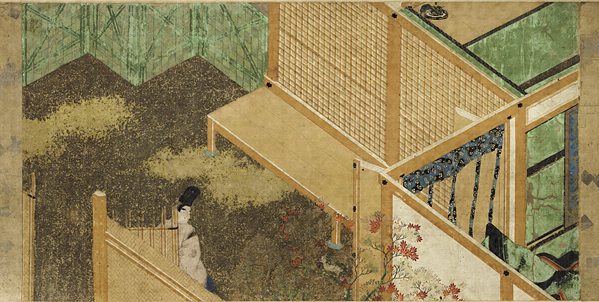
(Kobo Sou, Kubokebon Ise Monogatari Emaki, circa 1400)
The significance of boundaries in oriental culture is lost in Gile’s translation of ‘The Beautiful Toilet’ (Giles, A History of Chinese Literature, 1901) where the poem establishes very little distance and depth in regards to the woman and her environment:
Green grows the grass upon the bank,
The willow-shoots are long and lank;
A lady in a glistening gown
(1901, lines 1-3, page 97).
Due to the metre, the flow of the poem transitions from the imagery of the river to the woman with very little friction. The constant pentameter means that the same temporal space is attributed between each of the images: the distance between the river and the shoots are the same number of syllables as the bank and the woman, thereby establishing a flat poetic landscape.
In comparison, the landscape of Pound’s ‘The Beautiful Toilet’ contains distance and establishes boundaries: the first line of the poem is not end stopped and Pound connects the imagery of the river and the willows through the lack of a pause and barrier between them (1915, 1). In comparison, the third line, where we meet the woman, contains an embedded clause, is punctuated at the end and so the space surrounding the woman is broken up and lacks a freedom in the fluidity of the line. However, Pound not only establishes barriers but ‘The Beautiful Toilet’ works to transgress and penetrate them. To use Sou’s emaki as an analogy for ‘The Beautiful Toilet’, Pound acknowledges the boundary of the walls but smears the green of the floor into the other room, adds cracks, holes, and gaps in the barrier: the interchangeability of 蓝色 (blue) and 绿色 (green) is utilized in order to embody the fluidity of a watercolour painting where the blue of the water seeps into the grass that lies beside it and thus, the division of water and land is blurred. Even though the poem does not contain enjambment, the assonance of the “L” sound runs on from “Blue, blue” to the next line of “willows overfilled” (1915, 1-2). The assonance works within the metre to convey a sense of fluidity, a transgression through boundaries: the 10-12 syllable lines act as permeable wall that the echoes of the imagery can pass through.
The porous boundaries in ‘The Beautiful Toilet’ relate to the genre, Zhaoming Qian understands poems such as ‘The Beautiful Toilet’ as participating in the “solitary woman” (The Modernist Response to Chinese Art , 2003, 57) trope found in Chinese art. He describes the trope as “female complaints” (2003, 57) and claims that writers and painters engaging in the trope are drawing attention to the injustices done to women. Qian’s notion of “complaints” (2003, 58) can be split into two categories: direct and indirect complaints. The first notion seems to coincide with Giles’ approach to the genre as any sense of mystery concerning the woman’s fate in the poem is shattered by the final line: “He’ll find some day the bird has flown!” (Giles, A History of Chinese Literature, 1901, page 97). In comparison, Pound’s approach embodies the latter understanding, Pound’s notion of ‘The Vortex’ incorporates the same notion of stillness as ‘The Beautiful Toilet’ and traditional Chinese art through its indirectness: for example, the art during Ming dynasty used tranquil imagery such as dragonflies hovering over peaceful waters as a means of symbolising “political stability” (Patricia Bjaaland Welch, Chinese Art, 2013, 181). However, much like the vortex, the stillness is surrounded by movement and chaos: Li Zicheng’s, the peasants’, rebellion overthrew the Ming dynasty in 1644. In regards to ‘The Beautiful Toilet’, stillness is achieved through the silence of the woman regardless of her unjust situation: in the notes to ‘The Jewel Stairs’ Grievance’ (1915), Pound emphasises the importance of the muted woman as he claims that the poem is “especially prized” because the woman “utters no direct reproach” (1915, Notes). Therefore, for Pound, the idea of complaint does not rely on direct declaration but works through presentation and imagery. In regards to ‘The Beautiful Toilet’, the representation of complaint means that the woman’s suffering may not be heard but takes up space: the willows represent misery and confinement as they grow towards the floor instead of rising up into the air, they droop and pull towards the earth. Similar imagery is used in Qian Xuan’s 仕女图 (circa 1270) as the figure’s heavy, luxurious clothing and the detailed layers of the different fabrics seem weigh her down and convey a sense of restriction due to the flowing downward shape of the skirt and cape. However, the invasion of boundaries indicates her potential freedom: the willows that embody the woman’s gloom have spilled out of their confinement and “have overfilled the close garden” (1915, 2) conveying a movement from entrapment into freedom. Pound’s interpretation of the desolate woman relies on the construction of the image- having the complaint simmer underneath the surface, the woman’s silence works to convey her suffering as unjust: as Pound wrote in the notes to ‘The Jewel Stairs’ Grievance’, she is “not a servant who complains” (1915).
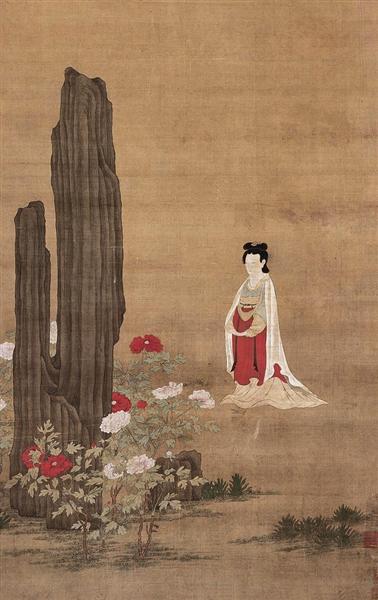
(Qian Xuan’s 仕女图 , circa 1270)
Confucius taught that“When you enter any state you can know what subjects [its people] have been taught” (Legge, The Sacred Books of China, Volumes 1-2 1879, 255) and when analysing ‘The Beautiful Toilet’ it is easy to find evidence of Fenollosa’s influence and similarly, Pound’s interest in the aesthetics of Chinese poetry and art. The ideogram became a stepping stone from poetry into the visual arts, through it Pound channelled his interest in precision, perception, and the image. Similarly, imagery prominent in Oriental art, capturing ancient ideologies, enabled Pound to engage with the genre of the solitary woman but, through the concentration of the image, worked towards a “natural suggestion” (Fenollosa, 1918, 45) rather than a “direct reproach” (Pound, 1915, Notes). Therefore, just like a flick of a brushstroke on a canvas or the choice of blue on a grassblade, the evidence for Pound’s enthusiasm for Chinese and Japanese art often lies in subtleties, the image, and the aesthetics of the poems themselves.
References
Fenollosa, E. (2008). The Chinese Written Character as a Medium for Poetry: A Critical Edition. 1st ed. Bronx: Fordham University Press.
Fritze, R., Olson, J. and Roberts, R. (1993). Reflections on world civilization. 3rd ed. New York: Harper Collins Publishers.
F.T.S (1914). The Causes and Remedy of the Poverty of China. The Egoist, [online] 1(6). Available at: https://library.brown.edu/pdfs/1305050375234379.pdf [Accessed 5 Dec. 2017]
Giles, H. (1901). A history of Chinese literature. 1st ed. London: D. Appleton and Company.
Legge, J. (1879). The Sacred Books of China, Volumes 1-2. 1st ed. Gloucestershire: The Clarendon Press.
Pound, E. (2010). Selected Poems and Translations. 1st ed. London: Faber and Faber.
Welch, P. (2014). Chinese Art. 1st ed. North Clarendon: Tuttle Publishing.
Ying-Ling Huang, M. (2010). ‘British interest in Chinese painting, 1881-1910: The Anderson and Wegener collections of Chinese painting in the British Museum’. Journal of the History of Collections, 22(2), pp.279-287.
Wilhelm, R. and Jung, C. (1950). The Book of Changes. 2nd ed. Princeton: Princeton University Press.
Qian, Z. (2003). The Modernist Response to Chinese Art. 1st ed. Virginia: University of Virginia Press.

